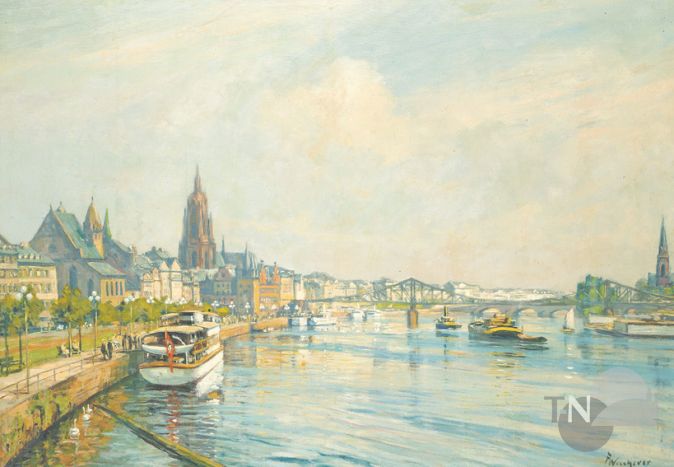
Fritz Wucherer, Frankfurt, 1933, oil on canvas, Stiftung Kronberger Malerkolonie
The artists’ colony in Kronberg was one of the most earliest in Germany in the 19th century. Altogether more than 100 artists worked in Kronberg from 1840 til 1948. Anton Burger’s move to Kronberg in 1858 is associated with the foundation of the Kronberg artists’ colony.
The history of the colony is closely connected with the nearby city of Frankfurt, where many of the artists, who we today count as part of the colony, were born. Besides the place of birth, these artists were connected in particular, through their common studies under Jakob Becker who held the Chair of genre and landscape painting at the Städel Art Institute in Frankfurt.
Back to nature
Through the removal to the rustic surroundings of the Taunus village, the artists reacted to increasing industrialization and technical changes in the big city culture. The rusticity instead, served them as a projection space for a more natural painting, since Anton Burger and his artist colleagues rebelled against the traditions and teaching methods of the academies. This was shown in their pictures by the rejection of composed landscapes excessively filled with allegorical ingredients or historical references. In future the original landscape and the rustic atmosphere would replace the motifs of historical painting. They also received important stimuli from Paris, Barbizon and the Netherlands. Through Burger’s pupils Nelson Kinsley, Philipp Franck and Fritz Wucherer increasingly impressionistic tendencies found their place in Kronberg’s painting oeuvre.
From rustic idyll to noble villa settlement
However, as in many other artists’ settlements, advances did not halt in Kronberg. At the end of the 19th century wealthy Frankfurt citizens discovered the small Taunus town as a health and holiday resort and built summer villas there.
From Empress Friedrich, the daughter of Queen Victoria and widow of Emperor Friedrich III, the town’s development experienced a considerable stimulus. Between 1889 and 1894 Schloss Friedrichshof was built as her widow’s residence. A society oriented artists’ group who were well off and close to the Empress, mow joined the “Back to Nature” movement. They turned their attention mainly to portraiture and historical painting.
As impressionism triumphed in Germany the artists’ colony gradually disintegrated. Since the death of Anton Burger in 1905 the growth of the colony had been severely restricted and the younger generation of artists Nelson G. Kinsley, Philipp Franck and Fritz Wucherer, despite adopting impressionistic tendencies in their painting could not revive the colony. In 1948 Fritz Wucherer and Emil Rumpf, the las official representatives of Kronberg artists’ colony, died.
Fritz Wucherer (1873 - 1948)
To mark the 150th anniversary of Fritz Wucherer‘s birth, the Kronberg Artists‘ Colony Foundation is presenting a comprehensive exhibition of the work of this versatile artist.
Kronberg, Frankfurt and Paris were Fritz Wucherer‘s most important town and cities for his work and form the focus of the exhibition, which includes around 70 works on loan from public and private collections.
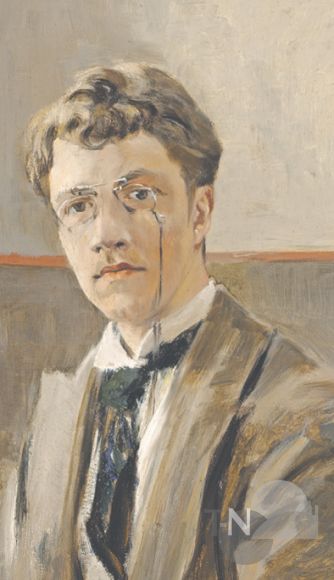
In 1877, Fritz Wucherer’s merchant‘s family moved from Basel to Frankfurt. From 1888, Fritz Wucherer received private drawing lessons there from the landscape painter Josef Müller. After completing his school education, Wucherer attended Anton Burger‘s studio in Kronberg from 1892 - 95. To complete his studies, he left for Paris in 1895, where he remained until 1897. Wucherer cultivated connections to Eugen Jettel and Eugène Boudin. Camille Corot and Charles Daubigny were among his role models. During the summer months, he was drawn to nearby Houilles, to Barbizon and he also had a studio in Auvers-sur-Oise for a time. This early phase of his work with his choice of motifs and coloration was clearly influenced by the Barbizon School and French Impressionism. Before returning to Frankfurt, he studied nude and figure drawing at the Académie Julian for three months.
In 1898, he joined the Frankfurt artists‘ society centred on Hans Thoma. On Thoma‘s advice, Wucherer experimented with the technique of lithography. One year later, he moved to Kronberg for good. After initial successes with colour-intensive studio paintings and harmonious impressions of nature, Wucherer became clearly the most productive artist in Kronberg. His preferred motifs included atmospheric landscapes and colourful views of towns and cities.
Having reached the height of his creative powers, after the turn of the century, Wucherer began to take an interest in technical engineering achievements. This turning point in the artist‘s choice of motifs is closely linked to the International Aviation Exhibition in Frankfurt in 1909 with his paintings of the Frankfurt Festhalle (exhibition hall) and airships. Pictures of technically innovative industrial buildings also followed. In 1913, for example, he was commissioned to document the demolition and new construction of the Old Bridge in Frankfurt.
In 1917 during the First World War he was a soldier on the Vosges front and returned to Kronberg in 1918. Wucherer spent the Second World War years 1942 - 44 in Großgmain in Austria and Deggingen in the Swabian Alb. He returned to Kronberg in 1946, and he died there in 1948.
Fritz Wucherer, Kronberg with the Schreyer Street, oil on canvas, Stiftung Kronberger Malerkolonie
Fritz Wucherer, Self-portrait, Paris 1896, oil on canvas, Private Collection