Main-Taunus-District
(mtd/mk) – The importance of protecting and preserving a fragile ecosystem with all its smallest creatures became clear at the beginning of August at the example of the butterfly population „Im Süßen Gründchen“. NABU Bad Soden has been looking after this area since 2007, always with the consultation of the „UNB“ – the Lower Nature Conservation Authority. Here, from „wilderness“, the valley was designed as it is today. In 2008 it was designated as a „FFH area“ (abbreviation for Fauna-Flora-Habitat).
The district is also specifically committed to the protection of two rare butterfly species. As First District Alderman Madlen Overdick announced, the animal ecological expert and graduate biologist Matthias Fehlow is investigating the populations of the Large Blue and Dusky Large Blue on behalf of the district. From this, measures for nature conservation would be derived, including the designation of protected areas. „We are thus making a contribution to the protection of native species,“ summarizes Overdick.
Climate change affecting stocks
The Large Blue is threatened with extinction in the district, elsewhere even disappeared already. According to the information, only two specimens of Large Blue were documented last year, currently it looks a little better. The Dusky Large Blue was found in 2021 with 200 specimens, so the number had collapsed dramatically, according to the words of the environmental department. The numbers of butterflies would be determined according to certain standards. They would not reliably give the exact size, but the order of magnitude.
The butterflies fly between the beginning of July and August, which is why Matthias Fehlow is currently investigating the two species. Experts suspect that the decline of the Blues is also related to climate change: The butterflies are dependent on two host ants, which apparently cannot cope with the increasingly dry summers and whose populations also suffer from climate change. In addition, in the dry years, the fodder plant Great Burnet does not grow fast enough after the first mowing, so that the plants for laying eggs are missing during the flight time of the butterflies.
Conservation measures
For 25 years now, the MTK has had the butterflies threatened throughout Europe examined. As a result, many of the prevalence could be preserved, explains Overdick. For example, farmers are financially compensated for not fertilizing the meadows and for adhering to certain butterfly-friendly mowing times. In addition to the expert, farmer Jürgen Schaar explained that grazing should also be avoided (the same principle as with mowing).
As a result, the levels of the Blues could be stabilized, at times even significantly increased. The „Sauerbornsbachtal near Schwalbach“ and the „Wiesen im Süßen Gründchen near Neuenhain“ are designated as protected areas for the Large Blues, which are specially managed for these species.
Significant decline in stocks
In Neuenhain, the Nature Conservation Union (NABU) Bad Soden is strongly committed to the care of the species. The farmer and the municipality are also involved in the protection efforts.
In earlier times, the number of butterflies in the Main-Taunus district of the Dusky Large Blue was estimated at more than 3,000 individuals in about 20 areas, of the rarer Large Blue to 350 individuals in five areas. In the meantime, the figures have shrunk compared to 2018 to a frightening stock of 5 to 10 percent.
How can the butterflies be helped?
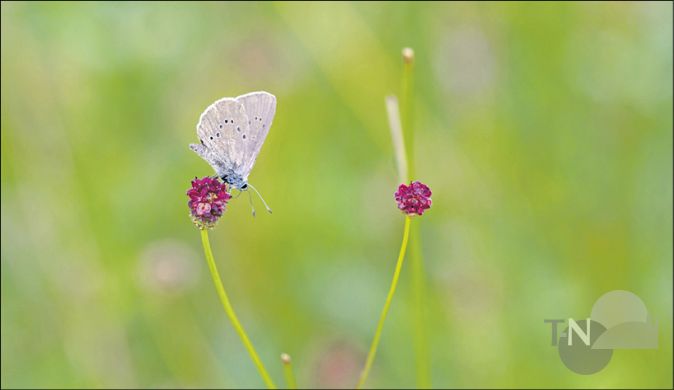
The adult butterflies suck on flowers of the Great Burnet and lay their eggs in it after mating. After hatching, the caterpillars live on the flowers for some time, but then migrate to the ground. There they are transported by certain ant species into their nests. Subsequently, they are fed by the ants or feed as parasites on the ant brood. The caterpillars hibernate in the ant burrows and pupate near the soil surface in the upper part of the nests. From the end of June, the butterflies hatch, leave the ant nests and mate in the area of the Great Burnet plants. This marks the beginning of the next annual cycle.
„The way of life of these butterfly species is an impressive example of how everything in nature is interrelated,“ says the head of the environmental department. „Our appreciation for the local nature is particularly evident in the protection of such smaller species.“ To preserve this magical world of different species, especially insects and butterflies, the correct handling of these habitats is essential.
A specimen of Dusky Large Blue.
Photo: Mirjam Kuschel